Effects of Structured Physical Activity on Holistic Development of Elementary School Children: A Systematic Review Based on Physical Literacy Framework
DOI:
https://doi.org/10.47945/misool.v8i1.3289Keywords:
Physical literacy, Structured physical activity, Elementary school Student, Motoric competence, Executive function, Systematic reviewAbstract
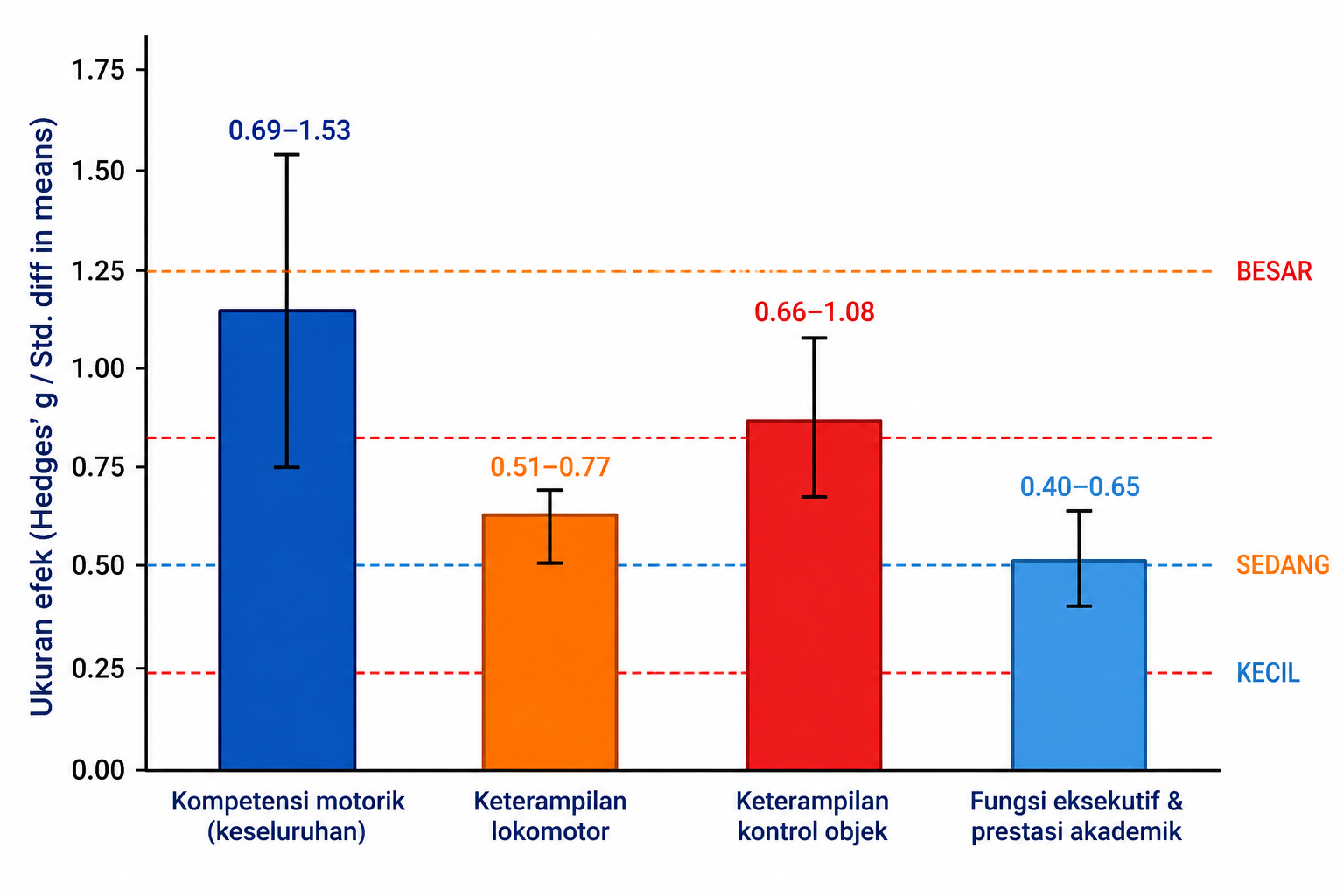
Elementary school years represent a critical period for establishing foundations of health, motor competence, and socio-emotional skills. Despite strong evidence supporting the multidimensional benefits of structured physical activity, sedentary lifestyles and excessive screen time among Indonesian children raise serious concerns. Objective: This systematic review aimed to synthesize contemporary empirical evidence regarding the impact of structured physical activity on the physical, cognitive, and psychosocial development of elementary school children through the Physical Literacy (PL) framework. Method: This review followed the PRISMA 2020 protocol across six electronic databases for studies published between January 2018 and July 2026. Inclusion criteria comprised experimental, quasi-experimental, or randomized controlled trial designs; populations aged 6–12 years; structured physical activity interventions; and reporting at least one outcome in physical, cognitive, or psychosocial domains. Methodological quality was assessed using the Mixed Methods Appraisal Tool (MMAT) version 2018. Results: Forty-two studies met the inclusion criteria. Large effect sizes for motor competence (Hedges' g = 0.69–1.53) and moderate effect sizes for executive function and academic achievement (d = 0.40–0.65) were drawn from previously published meta-analyses of individual intervention studies rather than computed de novo, as no meta-analysis was performed in this review. The included studies further reported positive associations with emotional regulation, self-esteem, and social skills. High heterogeneity indicated substantial variation in intervention design and implementation context. Conclusion: The included evidence, synthesized narratively and appraised using the MMAT, generally indicates positive associations between structured physical activity and holistic child development, with the strongest support for motor competence outcomes. Policy recommendations include adopting PL-based physical education curricula, strengthening teacher capacity, and revitalizing traditional games as culturally-relevant learning media.
References
Cairney, J., Dudley, D., Kwan, M., Bulten, R., & Kriellaars, D. (2019). Physical literacy, physical activity and health: Toward an evidence-informed conceptual model. Sports Medicine, 49(3), 371–383. https://doi.org/10.1007/s40279-019-01063-3
Carl, J., Barratt, J., Töpfer, C., Cairney, J., & Pfeifer, K. (2021). How are physical literacy interventions conceptualized? A systematic review on intervention design and content. Psychology of Sport and Exercise, 58, 102091. https://doi.org/10.1016/j.psychsport.2021.102091
Carl, J., Barratt, J., Wanner, P., Töpfer, C., Cairney, J., & Pfeifer, K. (2022). The effectiveness of physical literacy interventions: A systematic review with meta-analysis. Sports Medicine, 52(12), 2965–2999. https://doi.org/10.1007/s40279-022-01738-4
Chan, C. W. Y., Ha, A. S. C., Ng, J. Y. Y., & Lubans, D. R. (2019). The A + FMS cluster randomized controlled trial: An assessment-for-learning approach to improving fundamental movement skills and physical activity in primary schoolchildren. BMC Public Health, 19(1), 1588. https://doi.org/10.1186/s12889-019-7948-8
Chaput, J. P., Willumsen, J., Bull, F., Chou, R., Ekelund, U., Firth, J., Jago, R., Ortega, F. B., & Katzmarzyk, P. T. (2020). 2020 WHO guidelines on physical activity and sedentary behaviour for children and adolescents aged 5–17 years: Summary of the evidence. International Journal of Behavioral Nutrition and Physical Activity, 17(1), 141. https://doi.org/10.1186/s12966-020-01037-z
Costa, J. A., Vale, S., Cordovil, R., Rodrigues, L. P., Cardoso, V., Proença, R., & Gomes, T. (2024). A school-based physical activity intervention in primary school: Effects on physical activity, sleep, aerobic fitness, and motor competence. Frontiers in Public Health, 12, 1365782. https://doi.org/10.3389/fpubh.2024.1365782
Duncan, M. J., Noon, M., Lawson, C., Hurst, J., & Eyre, E. L. J. (2020). The effectiveness of a primary school based badminton intervention on children’s fundamental movement skills. Sports, 8(1), 11. https://doi.org/10.3390/sports8010011
Fu, T., Zhang, D., Wang, W., Geng, H., Lv, Y., Shen, R., Li, Y., & Sun, Y. (2022). Functional training focused on motor development enhances gross motor, physical fitness, and sensory integration in 5–6-year-old healthy Chinese children. Frontiers in Pediatrics, 10, 936799. https://doi.org/10.3389/fped.2022.936799
Gu, Y., Chen, Y., Ma, J., Ren, Z., Li, H., & Kim, H. (2021). The influence of a table tennis physical activity program on the gross motor development of Chinese preschoolers of different sexes. International Journal of Environmental Research and Public Health, 18(5), 2627. https://doi.org/10.3390/ijerph18052627
Hanifah, L., Nasrulloh, N., & Sufyan, D. L. (2023). Sedentary behavior and lack of physical activity among children in Indonesia. Children, 10(8), 1283. https://doi.org/10.3390/children10081283
Hong, Q. N., Fàbregues, S., Bartlett, G., Boardman, F., Cargo, M., Dagenais, P., Gagnon, M. P., Griffiths, F., Nicolau, B., O’Cathain, A., Rousseau, M. C., Vedel, I., & Pluye, P. (2018). The Mixed Methods Appraisal Tool (MMAT) version 2018 for information professionals and researchers. Education for Information, 34(4), 285–291. https://doi.org/10.3233/EFI-180221
Jiménez-Díaz, J., Chiva-Bartoll, O., & Martín-Moya, R. (2020). The effects of physical education on motor competence in children and adolescents: A systematic review and meta-analysis. International Journal of Environmental Research and Public Health, 17(16), 5734. https://doi.org/10.3390/ijerph17165734
Magistro, D., Cooper, S. B., Carlevaro, F., Marchetti, I., Magno, F., Bardaglio, G., & Eslami, R. (2022). Two years of physically active mathematics lessons enhance cognitive function and gross motor skills in primary school children. Psychology of Sport and Exercise, 63, 102254. https://doi.org/10.1016/j.psychsport.2022.102254
Nazari, S., Hossini, R. N. S., Norouzi, E., Manzano-Sánchez, D., & Pill, S. (2025). Combined teaching games for understanding and sport education in PE can improve student emotion regulation, intrapersonal intelligence and psychomotor skills. Acta Psychologica, 261, 105812. https://doi.org/10.1016/j.actpsy.2025.105812
Nicolosi, S., Greco, C., & Ancona, A. (2024). The effects of a 12-week interdisciplinary physical education program on gross motor skills and perceived motor competence in primary school children. Journal of Physical Education and Sport, 24(6), 1724–1732. https://doi.org/10.7752/jpes.2024.06217
Nurfauzan, P., Guntur, G., Pambudi, A. F., Ningsih, A. G., Fauzi, A. N. N., Triansyah, A., & Wibowo, A. (2025). Development and validation of a quantum learning model based on traditional games to improve physical literacy in primary school students. Retos, 69, 1401–1418. https://doi.org/10.47197/retos.v69.116823
Page, M. J., McKenzie, J. E., Bossuyt, P. M., Boutron, I., Hoffmann, T. C., Mulrow, C. D., Shamseer, L., Tetzlaff, J. M., Akl, E. A., Brennan, S. E., Chou, R., Glanville, J., Grimshaw, J. M., Hróbjartsson, A., Lalu, M. M., Li, T., Loder, E. W., Mayo-Wilson, E., McDonald, S., & Moher, D. (2021). The PRISMA 2020 statement: An updated guideline for reporting systematic reviews. BMJ, 372, n71. https://doi.org/10.1136/bmj.n71
Rizkyanto, W., Suherman, W., HariYuliarto, Pamungkas, G., & Wibowo, A. (2023). The effect of 12 weeks brain jogging based learning models to improve gross motor skill: Object control skill in elementary school. Retos, 50, 1265–1271. https://doi.org/10.47197/retos.v50.99730
Rudd, J., Buszard, T., Spittle, S., O’Callaghan, L., & Oppici, L. (2021). Comparing the efficacy (RCT) of learning a dance choreography and practicing creative dance on improving executive functions and motor competence in 6–7 years old children. Psychology of Sport and Exercise, 53, 101846. https://doi.org/10.1016/j.psychsport.2020.101846
Sankalaite, S., Huizinga, M., Dewandeleer, J., Xu, C., de Vries, N., Hens, E., & Baeyens, D. (2021). Strengthening executive function and self-regulation through teacher-student interaction in preschool and primary school children: A systematic review. Frontiers in Psychology, 12, 718262. https://doi.org/10.3389/fpsyg.2021.718262
Santos-Miranda, E., Cárcamo-Oyarzún, J., Carballo-Fazanes, A., Abelairas-Gómez, C., García-Massó, X., & Estevan, I. (2025). Exploring physical literacy in school contexts: A systematic review of qualitative evidence. Frontiers in Sports and Active Living, 7, 1713780. https://doi.org/10.3389/fspor.2025.1713780
Son, H. (2025). The impact of movement-integrated instruction on physical literacy development in elementary students. Education Sciences, 15(5), 545. https://doi.org/10.3390/educsci15050545
Telford, R. M., Olive, L. S., Keegan, R. J., Keegan, S., Barnett, L. M., & Telford, R. D. (2020). Student outcomes of the physical education and physical literacy (PEPL) approach: A pragmatic cluster randomised controlled trial of a multicomponent intervention to improve physical literacy in primary schools. Physical Education and Sport Pedagogy, 26(1), 97–110. https://doi.org/10.1080/17408989.2020.1799967
Vandenbroucke, L., Spilt, J., Verschueren, K., Piccinin, C., & Baeyens, D. (2018). The classroom as a developmental context for cognitive development: A meta-analysis on the importance of teacher–student interactions for children’s executive functions. Review of Educational Research, 88(1), 125–164. https://doi.org/10.3102/0034654317743200
Whitehead, M. (2010). Physical literacy: Throughout the lifecourse. Routledge.
Zhang, D., Wang, W., Fu, T., Geng, H., Lv, Y., Shen, R., Li, Y., & Sun, Y. (2024). Effect of intervention programs to promote fundamental motor skills among typically developing children: A systematic review and meta-analysis. Children and Youth Services Review, 152, 107041. https://doi.org/10.1016/j.childyouth.2023.107041
Downloads
Published
How to Cite
Issue
Section
License
Copyright (c) 2026 Aris Iskandar, Joni Taufik Hidayat

This work is licensed under a Creative Commons Attribution 4.0 International License.